
Table of Contents
- Why Does Dubai's Climate Destroy Bikes Faster Than Other Cities?
- What Should You Check on Your Bike Every Week in Dubai?
- How Do You Measure Chain Wear and When Should You Replace It?
- Which Chain Lube Works Best for Cycling in Dubai?
- How Should You Store Your Bike During Dubai's Summer?
- What Bike Maintenance Dubai Tools Should Every Rider Own?
- When Should You Take Your Bike to a Professional Mechanic?
- Frequently Asked Questions About Bike Maintenance Dubai
- Conclusion
Dubai summer temperatures regularly exceed 45C. Humidity can hit 90%. Fine desert sand works its way into every moving part on a bicycle.
These three forces shorten component life faster than almost any other cycling climate on the planet. Most bike maintenance content in the UAE comes from repair shops selling labour. The top search results are workshop menus, not practical guides.
This bike maintenance Dubai guide is for riders who want to keep their own bikes running. It covers weekly checks, monthly inspections, seasonal prep, lube selection for desert conditions, summer storage, and the essential products every UAE cyclist should own.
AK Bikes sells bike parts and accessories, not repair services. This guide exists to help riders maintain their own bikes with the right products.
Why Does Dubai's Climate Destroy Bikes Faster Than Other Cities?
Dubai's combination of extreme heat, coastal humidity, and abrasive desert sand accelerates drivetrain wear, corrodes steel components, and degrades rubber faster than temperate climates.
These three forces, heat, sand, and humidity, form what experienced UAE cyclists call the "climate triad." Each one attacks different parts of a bicycle, and together they create maintenance demands that generic cycling guides simply do not address.
Heat (40-50C)
Tire pressure increases roughly 1-2 PSI for every 5C rise in ambient temperature. A tire inflated to 100 PSI in an air-conditioned room can reach 110 PSI on a midday ride in July. That extra pressure increases the risk of blowouts on rough surfaces and reduces grip.
Beyond tires, heat evaporates chain lubricant faster, degrades rubber compounds on brake pads and handlebar grips, and can soften adhesive on bar tape. According to Dubai climate data, average highs in August sit above 41C, with inland areas pushing past 50C regularly.
Sand
UAE desert sand has a grain size between 0.1mm and 0.5mm. It acts as an abrasive compound inside the drivetrain, grinding against chain links, cassette teeth, and derailleur pulleys. Think of it as running fine sandpaper through every moving part of the bike.
Sand penetrates sealed bearings, headsets, and bottom brackets. Even brief exposure during a ride deposits enough grit to accelerate wear significantly over weeks. Forum discussions on MTBR confirm that desert riders consistently replace drivetrain components more frequently than riders in temperate climates.
Humidity (60-90% in Summer)
Coastal humidity in Dubai can reach 90% during summer months. That moisture triggers surface corrosion on steel and chrome parts. Chains, bolts, spoke nipples, cable ends, and quick-release skewers are the first components to show rust spots.
Riders who store bikes in non-climate-controlled garages during summer often find orange corrosion across the entire drivetrain by October.
What Should You Check on Your Bike Every Week in Dubai?
A weekly bike check in Dubai takes about 10 minutes and covers three areas: tire pressure, chain condition, and brake response.
Consistency matters more than intensity here. Bike maintenance Dubai riders often skip is the simple weekly routine, but a quick 10-minute check catches problems before they become expensive repairs.
Tire Pressure
Check pressure with a floor pump and gauge before every ride in summer. Because heat causes pressure to rise throughout the day, inflate to the lower end of the tire's recommended range for hot-weather rides.
For example, if a road tire is rated 80-130 PSI, inflate to 85 PSI before a summer morning ride. The pressure will climb naturally as the road surface heats up. Keeping tires at the correct pressure also prevents pinch flats and uneven tread wear.
Chain Condition
Wipe the chain with a dry rag after every ride. This removes surface sand before it works deeper into the links. Listen for grinding or clicking sounds while pedalling. A crunchy-sounding chain means sand is already inside the links and a deeper clean is needed.
A visual check works too. If the chain looks dusty or gritty rather than lightly oiled, it needs attention.
Brake Response
Squeeze both brake levers before every ride. The pads should contact the rim (or rotor, for disc brakes) firmly, with at least 2cm of lever travel remaining before the lever hits the handlebar. If the lever pulls too close to the bar, the brake cable needs tightening or the pads need replacing.
For disc brakes, also listen for scraping sounds while spinning the wheel. Sand contamination on the rotor surface causes noise and reduces stopping power.
How Do You Measure Chain Wear and When Should You Replace It?
A chain wear indicator tool measures chain stretch, sometimes called elongation. Replace the chain when the tool reads 0.75% elongation to avoid damaging the more expensive cassette and chainrings.
This is the single most important bike maintenance Dubai check for any cyclist in the UAE. A worn chain does not just shift poorly. It grinds down cassette teeth, and a new cassette costs far more than a new chain.
How Chain Wear Indicators Work
A chain wear indicator (also called a chain checker) is a small metal tool that slots between chain links. If the tool drops fully into the chain, the chain has stretched beyond its service limit. The tool costs a fraction of a cassette replacement and takes seconds to use. They are available in AK Bikes' tools collection.
Accelerated Wear in Desert Conditions
In Dubai's sandy conditions, chains wear roughly 30-50% faster than in temperate climates. A chain that lasts 3,000-5,000 km in northern Europe may only last 2,000-3,000 km in the UAE. Monthly checks catch elongation before it crosses the 0.75% threshold.
Monthly Inspection Checklist
Beyond the chain, these checks should happen monthly:
- Cable tension: shift through all gears on a bike stand or while riding slowly. If gears skip or hesitate, the barrel adjuster needs a quarter-turn.
- Spoke tension: squeeze pairs of spokes on each wheel. They should feel equally tight. A noticeably loose spoke means the wheel needs attention.
- Bearing play: grab the top of each wheel and rock it side to side. Any clicking or lateral movement indicates loose bearings.
- Brake pad inspection: check pad thickness visually. Most pads have wear indicators, grooves or lines that disappear when the pad is worn out.
Bike Maintenance Frequency Table
| Check | Frequency | What You Need |
|---|---|---|
| Tire pressure | Every ride (summer) / Weekly (winter) | Floor pump with gauge |
| Chain wipe | After every ride | Dry rag |
| Chain lube | Every 100-200 km | Dry chain lube |
| Chain wear measurement | Monthly | Chain wear indicator |
| Cable tension | Monthly | Barrel adjuster (hand) |
| Brake pad inspection | Monthly | Visual check |
| Bearing play | Monthly | Hand check (rock wheel) |
| Full drivetrain clean | Every 500 km or monthly | Chain cleaner, degreaser |

Which Chain Lube Works Best for Cycling in Dubai?
Dry lube is the best choice for Dubai cycling. It forms a non-sticky protective film that repels sand, while wet lube attracts grit and accelerates drivetrain wear in desert conditions.
This is arguably the most common question from UAE cyclists, and the answer is straightforward. According to Silca's lube comparison guide, dry lubes use a wax or PTFE-based formula that leaves a thin, dry layer on the chain. Sand particles do not stick to this film the way they stick to wet lube.
Why Dry Lube Wins in the Desert
Dry lube (wax-based or PTFE-based) coats the chain without leaving a sticky residue. Sand particles bounce off rather than embedding themselves into the links. The trade-off is that dry lube wears off faster, needing reapplication every 100-200 km, but the cleaner drivetrain more than compensates.
Wet lube, by contrast, stays on the chain longer but acts like a magnet for fine desert sand. Within a single ride, wet lube creates an abrasive paste of oil and grit that actively grinds through chain links, cassette teeth, and derailleur pulleys. Cycling Weekly's 2026 lube guide confirms that dry lubes significantly outperform wet options in dusty conditions.
How to Apply Dry Lube Correctly
- Clean the chain first. Never apply lube to a dirty chain. Use a chain cleaner or rag with degreaser to remove old lube and grit.
- Apply one drop of dry lube per chain link while slowly rotating the pedals backward.
- Let the lube sit for 5 minutes so the carrier solvent evaporates and the wax or PTFE bonds to the chain.
- Wipe off all excess with a clean rag. The chain should feel dry to the touch, not oily.
Lubing a dirty chain locks grit inside the links, which defeats the entire purpose. Always clean first. Browse the AK Bikes accessories collection for chain cleaning tools and lubricants.
Winter Exception
During cooler months (November through March), some riders switch to wet lube for early-morning rides with heavy dew or rides near the coast where salt air is a factor. Most experienced UAE cyclists still prefer dry lube year-round because sand remains present even in winter.

How Should You Store Your Bike During Dubai's Summer?
Store the bike indoors in a climate-controlled space, inflate tires to maximum rated pressure, apply a fresh coat of chain lube, and cover exposed metal with a light protective oil to prevent corrosion.
Many Dubai cyclists stop riding from June through September. Four months of incorrect storage causes flat-spotted tires, seized cables, corroded chains, and dried-out brake pads. Proper summer storage takes 30 minutes and prevents hundreds of dirhams in avoidable damage.
Summer Storage Checklist
- Clean the bike thoroughly. Remove all sand and grit from the frame, drivetrain, and wheels. Pay extra attention to the chain, cassette, and derailleur.
- Apply fresh dry lube to the chain after cleaning.
- Inflate tires to maximum rated pressure. This prevents flat spots from developing where the tire contacts the ground during months of sitting still.
- Spray exposed cables, bolts, and steel parts with a light oil or frame protectant to create a barrier against humidity-driven corrosion.
- Store indoors or in a climate-controlled space. Garage temperatures in Dubai can exceed 50C, which degrades rubber, evaporates lubricants, and warps plastic components.
- Use proper bike hooks if hanging the bike. Avoid hooks that clamp on carbon frames or pinch hydraulic brake hoses.
Returning to Riding After Summer
Before the first ride after summer storage, run through the full checklist:
- Re-check and adjust tire pressure
- Shift through all gears to verify cable tension
- Squeeze both brakes and confirm solid pad contact
- Re-lube the chain
- Spin each wheel to check for bearing play or brake rub
- Inspect tires for cracks in the rubber sidewall caused by heat exposure
If cables feel stiff or gears refuse to shift cleanly after adjustment, the inner cables may have corroded inside the housing and need replacement. Fresh cables and housing are available in the AK Bikes parts collection.
What Bike Maintenance Dubai Tools Should Every Rider Own?
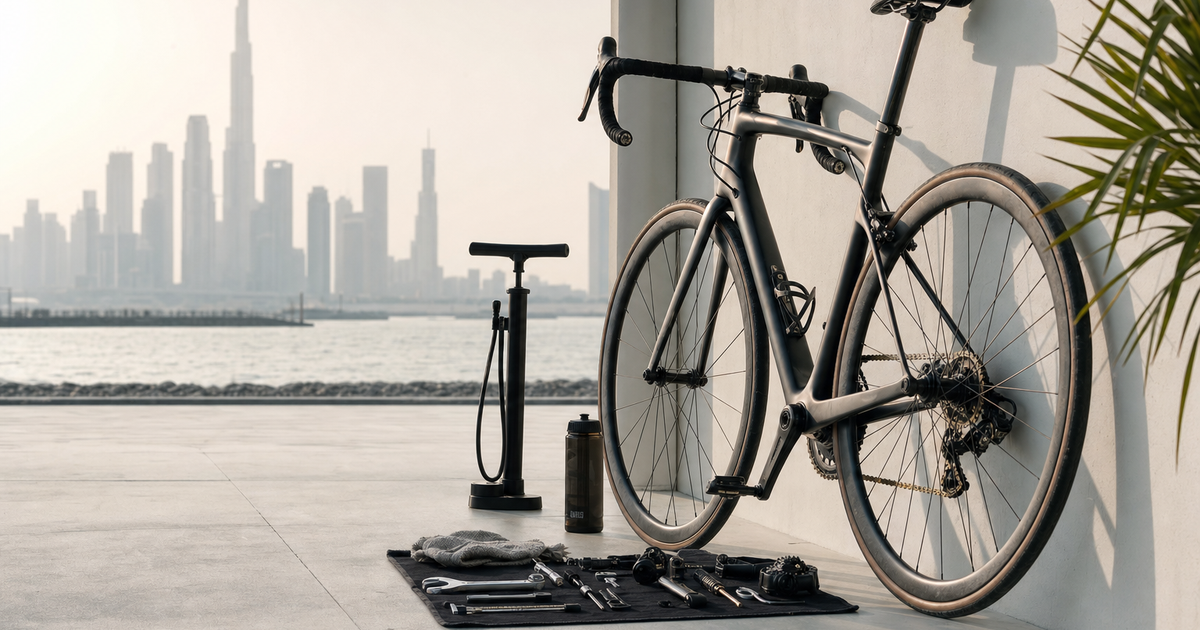
Five essential items cover roughly 90% of DIY bike maintenance in Dubai: a floor pump with gauge, a chain wear indicator, a multi-tool, dry chain lube, and tire levers with spare tubes.
These are not luxury items. For riders in the UAE, they are the baseline toolkit that makes every check in this guide possible.
- Floor pump with pressure gauge: A pump that reads both PSI and BAR is ideal for UAE tire standards. Digital gauges offer better precision for road tires. Check pressure before every summer ride. Shop pumps at AK Bikes.
- Chain wear indicator: A simple go/no-go tool. Insert it into the chain. If it drops in fully, the chain needs replacing. Browse tools at AK Bikes.
- Multi-tool: Hex keys, screwdrivers, and a chain breaker in one compact package. Carry it on every ride for trailside adjustments. Find multi-tools in the AK Bikes tools collection.
- Dry chain lube: The single most important consumable product for desert cycling. One bottle lasts months with regular application.
- Tire levers and spare tubes: Flat tires happen. Carry two tire levers and one spare tube on every ride. Practise changing a tube at home before needing to do it roadside.
When Should You Take Your Bike to a Professional Mechanic?
Take the bike to a professional for wheel truing, hydraulic brake bleeds, bottom bracket service, and headset bearing replacement. These tasks require specialist tools and training.
DIY bike maintenance Dubai riders can handle covers the majority of routine care. But some jobs fall outside the scope of a home toolkit, and attempting them without proper equipment risks damaging the bike.
- Wheel truing: Requires a truing stand and spoke wrench with precise, incremental tensioning. Incorrect truing can permanently damage rims or create spoke fatigue.
- Hydraulic brake bleed: Requires brand-specific bleed kits (Shimano and SRAM use different systems) and compatible brake fluid. Contaminated fluid causes complete brake failure.
- Bottom bracket service: Press-fit or threaded bottom bracket removal demands specific tools and correct torque values. Over-tightening damages the frame.
- Suspension service (MTB): Fork and rear shock internals need controlled environments, manufacturer-specified oils, and precision tools. This is workshop-only work.
For everything else, the right products and a consistent routine keep the bike running smoothly between professional services.
Frequently Asked Questions About Bike Maintenance Dubai
These are the most common questions Dubai cyclists ask about maintaining their bikes in the UAE climate.
How often should I service my bike in Dubai?
Perform weekly checks (tire pressure, chain, brakes) and monthly inspections (chain wear, cables, bearings). A professional service every 6-12 months covers what DIY cannot.
Can sand damage my bike?
Yes. Fine desert sand acts as an abrasive that accelerates chain, cassette, and derailleur wear. Regular cleaning and dry lube reduce sand damage significantly.
What lube should I use for cycling in Dubai?
Dry lube (wax or PTFE-based). It repels sand and keeps the drivetrain cleaner than wet lube, which attracts grit in desert conditions.
How do I protect my bike from humidity and corrosion in the UAE?
Store the bike indoors, wipe it down after rides, apply light oil to exposed steel parts, and replace the chain before corrosion spreads to the cassette.
Is it safe to leave my bike in a hot garage in Dubai?
Garage temperatures in Dubai can exceed 50C. This degrades rubber on tires, grips, and brake pads, and evaporates lubricants. A climate-controlled space is much safer for long-term storage.
Conclusion
Bike maintenance Dubai comes down to understanding three forces: heat, sand, and humidity. Every check, every product choice, and every storage decision ties back to managing that triad.
The most important takeaways:
- Dry lube, not wet. Sand sticks to wet lube and grinds through the drivetrain. Dry lube repels grit and keeps components cleaner.
- Check chain wear monthly. A chain wear indicator is the cheapest tool that prevents the most expensive repairs.
- Store properly over summer. Clean the bike, max out tire pressure, lube the chain, and protect metal from humidity.
- Weekly checks take 10 minutes. Tire pressure, chain condition, brake response. Consistency prevents expensive surprises.
Start this weekend. Pick one check from the weekly list and make it a habit before the next ride.
Everything needed for bike maintenance Dubai is available in the AK Bikes parts and accessories collections.

Leave a comment
This site is protected by hCaptcha and the hCaptcha Privacy Policy and Terms of Service apply.