
📑 Table of Contents
- Why Does Bike Size Matter So Much?
- How Do You Measure Yourself for a Bike?
- What Size Bike Do You Need? Bike Size Guide by Type
- How Do You Check Bike Fit in Person?
- What Adjustments Fine-Tune Your Bike Fit?
- How Does Sizing Differ Between Bike Brands?
- Frequently Asked Questions About Bike Sizing
- Conclusion
A bike that is one size too large or too small turns every ride into a fight against discomfort. Sore knees, a stiff lower back, numb hands: these problems almost always trace back to one root cause. The frame does not fit the rider.
The tricky part? Size charts vary between brands and bike types. A Trek Medium is not the same reach as a Giant Medium. And if you are shopping for a pre-loved bike, the perfect size might not be on the shop floor. This complete bike size guide covers how to measure yourself, read size charts for road, mountain, and hybrid bikes, check fit in person, and adjust a pre-loved bike that is close but not quite perfect.
Whether you are buying your first bicycle or upgrading from a frame that never felt right, this bike size guide will get you into the correct size range with confidence.
Why Does Bike Size Matter So Much?
Riding a wrong-size bike causes knee pain, lower back strain, and hand numbness, and it significantly reduces pedaling efficiency and control.
A frame that is too large forces the rider to overreach for the handlebars. The lower back rounds to compensate, shoulders tense up, and within 20 minutes of riding, the pain starts creeping in. Numb hands follow because too much weight shifts onto the palms.
A frame that is too small creates the opposite problem. The knees compress with every pedal stroke, the rider sits too upright, and aerodynamic efficiency drops. Many riders unknowingly stick with a too-small bike because "I can touch the ground easily" feels reassuring, even though it sacrifices comfort and power.
Here is the key number: correct sizing keeps the knee at a 25-35 degree bend at the bottom of the pedal stroke. That range maximizes power transfer while protecting the joint from overextension or compression. Outside that range, every ride chips away at comfort and long-term knee health. Any reliable bike size guide starts with this principle.
So how do you figure out what size fits? It starts with two simple measurements.
How Do You Measure Yourself for a Bike?
Measure your total height and your cycling inseam (floor to crotch while standing with feet 15 cm apart) to find your starting frame size range.
Height
Stand against a wall without shoes. Have someone mark the wall at the top of your head, then measure from the floor to that mark. Write it down in both centimeters and feet/inches so you can use any size chart.
Inseam (The More Important Measurement)
Your cycling inseam is the single most accurate predictor of frame size. It differs from your trouser inseam by 2-3 cm because the measurement method is different.
- Stand with your back against a wall, feet about 15 cm (6 inches) apart.
- Place a hardback book between your legs, spine facing up.
- Press the book firmly upward as if sitting on a bicycle saddle.
- Have someone measure from the top of the book's spine straight down to the floor.
- Record the number in centimeters.
Arm Length (Optional but Useful)
Measure your full wingspan (fingertip to fingertip with arms stretched out) and divide by two. This number helps with reach and stem decisions later, especially if your torso is longer or shorter than average for your height.
With these measurements in hand, the next step is matching them to a frame size for your bike type.
What Size Bike Do You Need? Bike Size Guide by Type
Use your height and inseam to match against the charts below for road, mountain, or hybrid bikes.
Every bike size guide breaks bikes into three main categories: road bikes sized in centimeters, mountain bikes in inches or S/M/L, and hybrids in S/M/L.

Road Bike Size Chart
| Height (cm) | Height (ft/in) | Frame Size (cm) | General Size |
|---|---|---|---|
| 152-160 | 5'0"-5'3" | 47-49 | XXS |
| 160-168 | 5'3"-5'6" | 50-52 | XS-S |
| 168-175 | 5'6"-5'9" | 53-55 | S-M |
| 175-183 | 5'9"-6'0" | 56-58 | M-L |
| 183-191 | 6'0"-6'3" | 58-60 | L-XL |
| 191+ | 6'3"+ | 61-63 | XXL |
Road bike frame size is measured from the center of the bottom bracket to the top of the seat tube. This is the number printed on the frame or listed in the specs.
Mountain Bike Size Chart
| Height (cm) | Height (ft/in) | Frame Size (in) | General Size |
|---|---|---|---|
| 152-162 | 5'0"-5'4" | 13.5"-15" | XS |
| 162-170 | 5'4"-5'7" | 15"-17" | S |
| 170-178 | 5'7"-5'10" | 17"-19" | M |
| 178-185 | 5'10"-6'1" | 19"-21" | L |
| 185-193 | 6'1"-6'4" | 21"-23" | XL |
| 193+ | 6'4"+ | 23"+ | XXL |
Most modern mountain bikes use 29-inch wheels for size M and above, and 27.5-inch wheels for size S and below. The wheel size affects handling and comfort, so factor that in alongside frame measurements.
Hybrid / City Bike Size Chart
| Height (cm) | Height (ft/in) | Frame Size (cm) | General Size |
|---|---|---|---|
| 152-162 | 5'0"-5'4" | 38-42 | XS |
| 162-170 | 5'4"-5'7" | 43-47 | S |
| 170-178 | 5'7"-5'10" | 48-52 | M |
| 178-185 | 5'10"-6'1" | 53-56 | L |
| 185-193 | 6'1"-6'4" | 57-60 | XL |
Hybrids use a more upright geometry than road bikes, so the riding position feels roomier even at the same nominal frame size.
Quick Formulas
If you want a shortcut, these inseam-based formulas give a solid starting point:
- Road bike frame (cm): Inseam (cm) x 0.665
- Mountain bike frame (inches): Inseam (cm) x 0.225
- Hybrid bike frame (cm): Inseam (cm) x 0.685
Round to the nearest whole number and cross-reference with the charts above.
Charts give a starting range, but nothing replaces checking the bike physically. Here is the simplest in-person test.
How Do You Check Bike Fit in Person?
Straddle the bike's top tube with both feet flat on the ground. You need 2-5 cm of clearance between the tube and your body for a safe, comfortable fit.
The Standover Test
- Stand over the bike with it between your legs, both feet flat on the floor.
- Check the gap between the top tube and your body.
- For road bikes, aim for 2-3 cm of clearance. For mountain bikes, aim for 5 cm or more (extra clearance protects you on rough terrain).
- If the tube presses against you, the frame is too large. Move down a size.
Note: step-through frames (common on city bikes) skip this test entirely since there is no horizontal top tube.
The Saddle Height Check
Sit on the saddle and place your heel on the pedal at its lowest point. Your leg should extend fully with the knee straight. When you switch to riding position (ball of your foot on the pedal), you naturally get that ideal 25-35 degree knee bend.
The formula: Saddle height = inseam x 0.883. Measure from the center of the bottom bracket to the top of the saddle. This gives a reliable baseline that most riders fine-tune over a few rides.
The Reach Check
While seated with your hands on the handlebars, your elbows should have a slight bend of about 15-20 degrees. If your arms lock straight, the frame's reach is too long. If your elbows are deeply bent, it is too short. Reach is the easiest dimension to adjust with a different stem, so do not rule out a bike based on reach alone.
Frame size and saddle height are the foundation, but three more adjustments make the difference between "fits okay" and "fits perfectly."
What Adjustments Fine-Tune Your Bike Fit?
Saddle height, stem length, and handlebar position are the three adjustments that transform a close-fitting frame into a perfectly comfortable ride.

Saddle Height
The most impactful single adjustment on any bike. Use the formula: inseam x 0.883. Measure from the center of the bottom bracket axle to the top of the saddle along the seat tube. Start there and make small 5 mm adjustments up or down over a few rides until your knees feel right.
Stem Length and Angle
The stem connects the handlebars to the fork steerer tube. Swapping it is one of the cheapest and fastest fit changes available.
- Shorter stem (60-80 mm): brings the handlebars closer to you, ideal if the frame's reach feels too long
- Longer stem (100-120 mm): pushes the handlebars further out, useful if the frame feels compact
Swapping a stem typically costs AED 50-150 for the part and takes about 10 minutes. It is one of the most practical adjustments for pre-loved bike buyers.
Handlebar Width and Position
Handlebar width should roughly match your shoulder width. Wider bars provide more control at low speeds (great for mountain bikes), while narrower bars are more aerodynamic (better for road riding). Tilting the bars up or down also changes your wrist angle and weight distribution.
Seatpost Setback
Moving the saddle forward or backward on its rails adjusts where your knee sits relative to the pedal spindle. A common starting reference: when the pedal is at the 3 o'clock position and your foot is on it, your kneecap should be directly above the pedal axle. This is the KOPS (Knee Over Pedal Spindle) guideline.
Sizing a Pre-Loved Bike
When buying pre-loved, the exact frame size you need might not be available. As Buycycle's used bike sizing guide confirms, a bike one size smaller or larger can still work with the right adjustments.
One size down (smaller frame): - Extend the seatpost to raise the saddle - Add a longer stem (100-120 mm) to increase reach - Raise the handlebars with spacers - This combination works well for riders with longer legs relative to their torso
One size up (larger frame): - Shorten the stem (60-80 mm) to reduce reach - Lower the saddle - Tilt the handlebars up slightly for a more upright position - This works best for riders with a longer torso relative to their legs
When to walk away: If the standover clearance is less than 1 cm, the frame is genuinely too large. If the seatpost is already at its minimum insertion mark and the saddle is still too high, that is another dealbreaker. These are not problems you can fix with components.
At AK Bikes' Umm Ramool store, staff can help adjust any pre-loved bike on the spot, so you leave with a fit that works for your body.
How Does Sizing Differ Between Bike Brands?
Trek, Giant, and Specialized all define "Medium" differently. A Trek Medium (54 cm) rides shorter than a Giant Medium (M/L) due to different frame geometry and design philosophy.
This matters when you are comparing pre-loved bikes from different brands side by side. Here is what to expect from the most common brands at AK Bikes:
- Trek sizes conservatively and uses numeric cm sizing on road bikes. A Trek 54 typically has a shorter reach than a competitor's 54. Good for riders who prefer a slightly more upright position.
- Giant uses a compact geometry that runs shorter in the seat tube. Their S/M/L labels do not map directly to other brands. Compare the "effective top tube length" instead of relying on the size label.
- Specialized runs slightly small in their road range. A rider who wears Medium in Trek may need a 56 or M/L in Specialized.
- Merida, Scott, BMC follow traditional European cm sizing with minor variations in reach. These brands tend to be more consistent with each other.
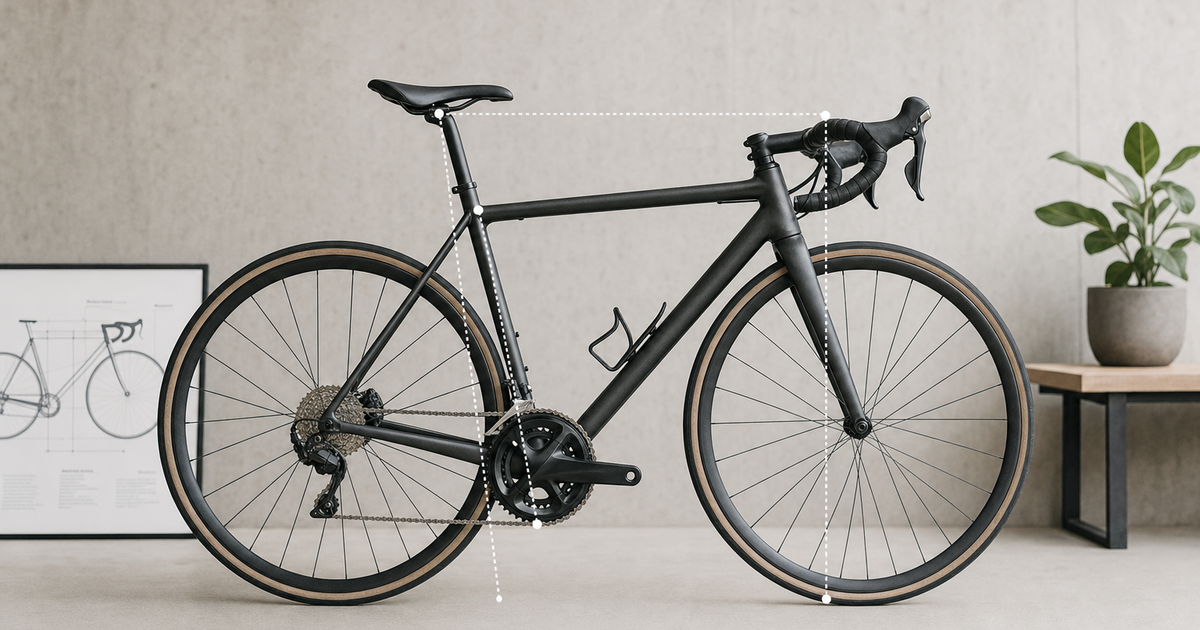
The best apples-to-apples comparison across any two bikes is stack and reach, as BikeRadar's geometry guide explains in detail. Stack measures the vertical distance from the bottom bracket to the top of the head tube. Reach measures the horizontal distance. Every manufacturer publishes these numbers in their geometry charts online. No bike size guide is complete without understanding these two metrics.
When shopping for pre-loved bikes at AK Bikes, check the geometry chart for the specific model and year rather than assuming a "Medium" from one brand matches another.
Frequently Asked Questions About Bike Sizing
These are the most common bike sizing questions riders ask when visiting AK Bikes in-store every week.
What size bike do I need if I am 5'8" (173 cm)?
At 173 cm, most riders fit a 54 cm road bike (Medium), a 17-18 inch mountain bike (Medium), or a 48-50 cm hybrid. Confirm with your inseam. If your legs are longer than average for your height, consider sizing up to a 56 cm road or 19-inch MTB.
How do I know if my bike is too big?
The clearest signs are stretched-out arms when holding the handlebars, lower back pain that starts within the first 20 minutes of a ride, difficulty reaching the brake levers comfortably, and less than 2 cm of standover clearance. Try shortening the stem first. If pain persists, the frame may be too large for your body.
Can I adjust a bike that is slightly the wrong size?
Yes, in most cases. Stem length, saddle height, seatpost setback, and handlebar angle can compensate for one size up or down. Two or more sizes off is a different story, and you should look for a different frame.
Is it better to size up or size down when between sizes?
Size down for aggressive or performance riding. A smaller frame gives more control and a sportier position. Size up for comfort, commuting, or touring. Dubai commuters and casual riders typically prefer sizing up for a more relaxed, upright posture.
What is the difference between bike size and bike fit?
Size is the frame measurement, and it is fixed once the bike is built. Fit is the full contact point setup: saddle position, pedal interface, handlebar reach, and grip angle. Size gets you in the right ballpark. Fit dials in the comfort. Both need to be right, but only fit is adjustable after purchase.
Conclusion
Correct bike sizing requires measuring your body, matching charts, and fine-tuning fit at the contact points.
This bike size guide comes down to five practical steps:
- Measure your height and cycling inseam
- Check the chart for your bike type (road, mountain, or hybrid)
- Standover test the bike in person for 2-5 cm clearance
- Set saddle height using the inseam x 0.883 formula
- Fine-tune stem length, handlebar position, and seatpost setback
For pre-loved bikes, remember that one size off is usually workable with stem and seatpost adjustments. Two sizes off is not. And when comparing brands, ignore the S/M/L labels and compare stack, reach, and effective top tube length instead.
A note for Dubai riders: if you ride casually around JLT, Downtown, or the Marina, a slightly more upright position keeps things comfortable in stop-and-go traffic. For performance loops at Al Qudra or NAS, a lower, more aggressive position pays off in speed and efficiency. Your riding style should influence both size and fit setup.
The best way to confirm your size is to try the bike. Stop by AK Bikes in Umm Ramool to test ride a few sizes, or browse the full pre-loved collection online and use the charts in this guide to narrow your options. AK Bikes' quick-reference size guide is also worth bookmarking for future reference.



Leave a comment
This site is protected by hCaptcha and the hCaptcha Privacy Policy and Terms of Service apply.